
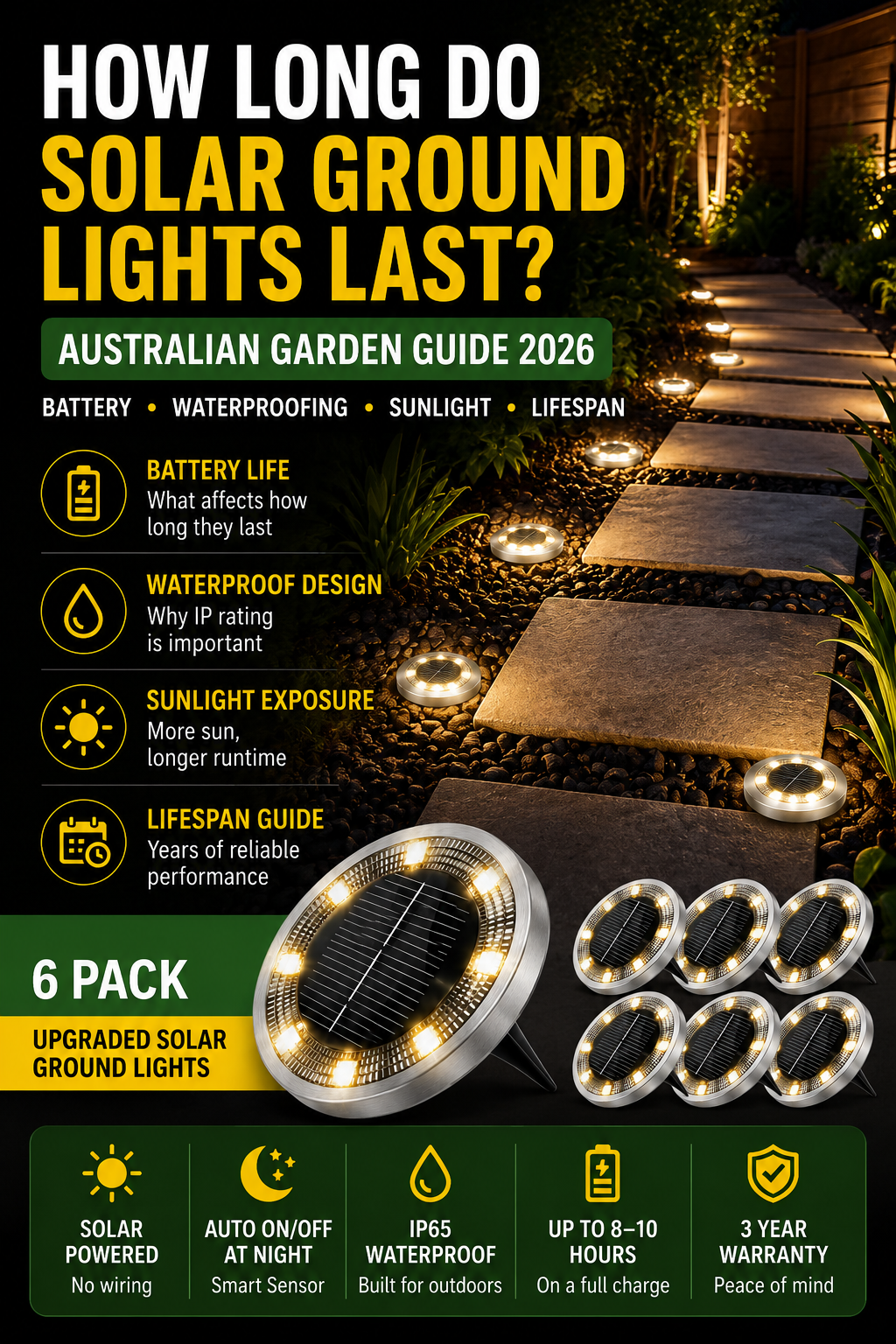
Solar ground lights are a simple way to add pathway, driveway and garden lighting without running mains electrical wiring through the yard.
But one of the most common questions Australian homeowners ask before buying is: how long do solar ground lights actually last?
The answer depends on two different things: how many hours the lights operate each night, and how many years the product itself lasts before components such as the rechargeable battery, solar panel or housing begin to deteriorate.
Quick Answer: How Long Do Solar Ground Lights Last?
A good-quality solar ground light can typically provide useful service for several years, although battery performance will gradually decline over time.
Nightly operating time depends on how much solar energy is collected during the day. In good sunlight conditions, many solar garden lights can operate for several hours after dark.
Actual performance varies according to:
- Daily sunlight exposure
- Season and weather
- Battery condition
- Solar panel cleanliness
- Water resistance and sealing quality
- Temperature
- LED power consumption
- Installation location
What Determines the Lifespan of Solar Ground Lights?
Solar ground lights contain several components, and each one affects the overall service life of the product.
1. Rechargeable Battery
The battery is often one of the first components to lose performance over time.
Every day, the battery is charged by the solar panel and then discharged at night. After many charging cycles, its capacity gradually decreases.
As battery capacity declines, you may notice that the light still turns on at night but does not remain illuminated for as long as it did when new.
2. Waterproofing and Housing
Ground lights are installed close to soil, grass and irrigation systems, so they are frequently exposed to water and moisture.
If water enters the light housing, corrosion can damage the battery, circuit board, LED components and electrical contacts.
This is one reason why construction and sealing quality are particularly important for ground-mounted solar lights.
For more information about common failures, see our guide: Why Solar Ground Lights Fail in Australian Gardens.
3. Solar Panel Condition
A dirty or damaged solar panel collects less energy.
Dust, leaves, bird droppings and garden debris can gradually reduce charging performance, especially when lights are installed close to the ground.
Cleaning the solar panel periodically can help maintain charging efficiency.
4. Sunlight Exposure
Even a high-quality solar light may perform poorly if it is installed in heavy shade.
Nearby trees, fences, walls and buildings can reduce the amount of useful sunlight reaching the solar panel.
For best results, place solar ground lights where their panels receive good daylight exposure during the day.
How Long Do Solar Ground Lights Stay On at Night?
Nighttime operating time can vary significantly depending on charging conditions.
After a good day of sunlight, solar garden lights may remain on for several hours after sunset. During cloudy weather or winter, operating time may be shorter because the battery receives less energy during the day.
Factors that influence nighttime runtime include:
- Hours of direct or useful sunlight
- Battery size and condition
- LED brightness
- Temperature
- Cloud cover
- Age of the light
It is normal for solar lighting performance to vary from one night to another because the system depends on available solar energy.
Do Solar Ground Lights Last as Long in Winter?
Solar ground lights can continue to operate during winter, but shorter daylight hours and lower sun angles can reduce daily charging.
In many parts of Australia, winter performance may therefore be lower than summer performance.
This does not necessarily mean the light is faulty. It may simply have received less solar energy during the day.
To improve winter performance:
- Keep the solar panel clean
- Remove leaves and garden debris
- Avoid heavily shaded positions
- Make sure nearby plants are not covering the panel
- Allow the light to receive maximum available daylight
Why Do Solar Ground Lights Stop Working?
There are several common reasons why a solar ground light may stop operating or become noticeably dimmer.
Not Enough Sunlight
The battery may not receive enough energy to power the light properly at night.
Dirty Solar Panel
Dirt or debris can reduce charging performance.
Battery Has Aged
Rechargeable batteries gradually lose capacity after repeated charging cycles.
Water Has Entered the Housing
Moisture can corrode internal electrical components and may permanently damage the light.
Solar Panel Is Covered
Plants, leaves or surrounding objects may block sunlight from reaching the panel.
Switch or Sensor Problem
Some solar lights include an on/off switch or light sensor. If either is damaged or incorrectly positioned, the light may not operate normally.
How Can You Make Solar Ground Lights Last Longer?
A few simple maintenance steps can help improve both daily performance and long-term reliability.
Keep the Solar Panel Clean
Wipe the solar panel periodically with a soft damp cloth to remove dust and dirt.
Choose a Sunny Installation Position
Do not place the light directly under dense plants, roof overhangs or permanent shade if another position is available.
Avoid Permanently Waterlogged Areas
Outdoor weather resistance does not mean a light should remain permanently submerged in standing water unless it is specifically designed for that use.
Do Not Cover the Solar Panel
Check regularly that plants have not grown over the panel.
Choose Better-Sealed Lights
Because solar ground lights sit close to wet soil and garden irrigation, a well-sealed housing can help protect internal components from moisture.
Do Solar Ground Lights Need Their Batteries Replaced?
Some solar garden lights allow the rechargeable battery to be replaced, while others use sealed construction that is not designed for routine battery replacement.
If a light becomes noticeably dimmer after extended use, the battery may have lost capacity.
Before assuming the battery has failed, check that the solar panel is clean and receiving enough sunlight.
How Long Does a Solar Panel Last?
The solar panel itself can usually continue operating for years, but its charging efficiency may decrease if the surface becomes damaged, heavily scratched, cloudy or permanently dirty.
In most small solar garden lights, battery condition and water ingress are more likely to cause noticeable performance problems before the solar panel completely stops functioning.
Are Solar Ground Lights Worth Buying?
Solar ground lights can be a practical option for homeowners who want decorative outdoor lighting without mains electrical wiring.
They are particularly useful for:
- Garden pathways
- Driveway edges
- Garden beds
- Patios
- Landscape borders
- Outdoor entertaining areas
The key is choosing a product designed for outdoor garden conditions rather than simply choosing the cheapest available light.
What Should You Look for When Buying Solar Ground Lights?
When comparing solar ground lights, consider:
- Outdoor sealing and water resistance
- Housing durability
- Solar panel exposure
- Battery quality
- Automatic dusk-to-dawn operation
- Installation method
- Warranty
For a more complete buying guide, read: Best Solar Ground Lights for Australian Gardens.
Solar Garden Ground Lights
Solar Garden's current ground lights are designed for outdoor garden, pathway and landscape applications without mains wiring.
Key benefits include:
- Solar powered operation
- Automatic nighttime lighting
- No mains wiring required
- Easy garden installation
- Suitable for pathways and landscape areas
- Australian stock
- Free AU delivery
- 3-year warranty
Frequently Asked Questions
How many years do solar ground lights last?
Product lifespan varies according to battery quality, sealing, weather exposure, charging conditions and general construction. Good-quality outdoor solar lights can provide useful service for several years, although battery capacity gradually declines over time.
How many hours should solar lights stay on?
Runtime varies according to sunlight, battery condition and season. After good daytime charging, many solar garden lights can operate for several hours after sunset.
Why do my solar lights only stay on for a few hours?
The most common reasons are insufficient sunlight, cloudy weather, an aging battery, dirt on the solar panel or excessive shade.
Do solar lights work on cloudy days?
They can still collect some energy under cloudy conditions, but charging may be reduced compared with a clear sunny day.
Do solar lights work in winter in Australia?
Yes, but shorter daylight hours and lower solar exposure can reduce nighttime operating time.
Can rain damage solar ground lights?
Outdoor-rated solar ground lights are designed for normal weather exposure. However, damaged seals or poor housing construction can allow moisture to reach internal components.
How can I make my solar garden lights last longer?
Keep the solar panel clean, provide good sunlight exposure, avoid permanently waterlogged locations and choose products with durable outdoor construction.
Final Thoughts
How long solar ground lights last depends on much more than the LED itself.
Battery quality, waterproofing, solar panel condition, sunlight exposure and installation location all influence both nightly performance and long-term lifespan.
A well-positioned and well-maintained solar ground light can continue providing useful garden lighting for years, while a poorly sealed product installed in heavy shade or standing water may fail much sooner.
For Australian gardens, focus on durable construction, good sealing and correct solar positioning rather than choosing only by price.