Solar spotlights are a practical way to highlight trees, garden beds, pathways, walls and outdoor features without installing mains electrical wiring.
For Australian gardens, choosing the right solar spotlight is not simply about finding the highest advertised brightness. Solar panel performance, beam direction, weather resistance, installation position and the amount of sunlight available during the day can all affect the final result.
This guide explains what to look for when choosing solar spotlights for an Australian garden and how to select the right type of light for different outdoor applications.
Quick Answer: What Should You Look for in a Solar Spotlight?
For most Australian gardens, a good solar spotlight should combine useful brightness, adjustable aiming, weather-resistant construction, reliable solar charging and simple installation.
When comparing solar garden spotlights, look for:
- Strong light output for the intended application
- An adjustable light head
- Weather-resistant outdoor construction
- A solar panel positioned for good daylight exposure
- Automatic dusk-to-dawn operation
- No mains wiring requirement
- Simple garden installation
- A meaningful product warranty
The best model depends on what you want to illuminate. A small garden feature requires much less light than a large tree, wall or driveway entrance.
What Are Solar Spotlights Best Used For?
Unlike solar ground lights, which are generally used to define pathways and landscape edges, spotlights are designed to direct light toward a specific object or area.
Common applications include:
- Illuminating trees
- Highlighting garden beds
- Lighting feature walls
- Accenting architectural details
- Illuminating signs or entrances
- Adding light around pathways
- Highlighting statues and landscape features
- Adding directional lighting around patios and backyards
Because the light is directional, a solar spotlight can create a stronger visual effect on a particular feature than a small decorative ground light.
How Bright Should a Solar Spotlight Be?
Brightness should be matched to the application rather than judged by a single number.
For example, a small plant or garden feature may only require moderate illumination, while a mature tree or large wall normally requires considerably more light.
When comparing products, consider both the advertised light output and how effectively the fixture directs that light toward the target.
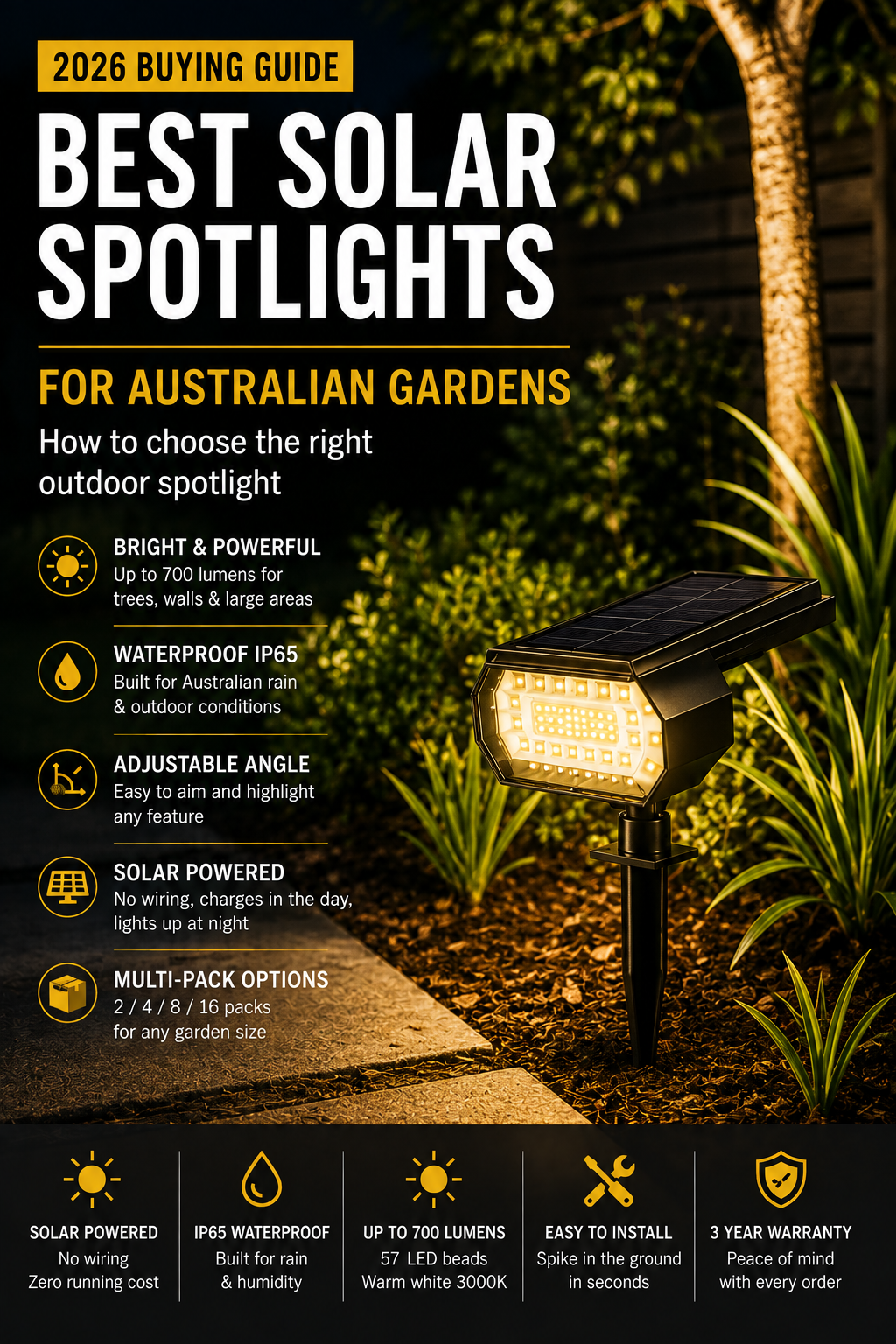
Solar Garden's current solar landscape spotlight uses 57 LED beads and is designed to provide strong warm-white directional illumination for outdoor garden applications.
Why Is an Adjustable Light Head Important?
An adjustable spotlight allows you to control where the light is directed.
This is particularly useful for trees and landscaping because the best angle depends on the height, shape and position of the feature.
For example:
- A tree can be illuminated upward from near its base.
- A garden bed can be illuminated from a lower angle.
- A wall can be illuminated by directing the beam toward its surface.
- A feature plant can be highlighted independently from the surrounding garden.
Adjustability also makes it easier to change the lighting design later as plants grow or the garden layout changes.
Do Solar Spotlights Need Direct Sunlight?
Solar lights depend on the energy collected by their solar panels during the day.
For best performance, install the solar panel where it can receive good daylight exposure. Avoid locations that remain heavily shaded by trees, buildings, fences or roof overhangs for most of the day.
Actual nighttime operating time can vary according to:
- Available sunlight
- Season
- Weather conditions
- Solar panel orientation
- Battery condition
- Selected operating mode
Australian summer conditions can provide long periods of daylight, but placement is still important. A solar panel under dense vegetation may receive limited useful sunlight even on a bright day.
Do Solar Spotlights Work in Winter?
Yes, solar spotlights can operate during winter, but performance may differ from summer.
Winter generally brings shorter daylight hours and a lower sun angle. Cloudy conditions can also reduce the amount of energy collected during the day.
To improve winter performance, keep the solar panel clean and position it where it receives as much useful daylight as practical.
Are Solar Spotlights Waterproof?
Outdoor solar spotlights should be designed for exposure to normal outdoor weather conditions.
For Australian gardens, this is important because lights can be exposed to rain, sprinklers, humidity and changing weather conditions.
Solar Garden's current outdoor spotlight is designed with IP65 weather-resistant protection for outdoor garden use.
However, weather resistance should not be confused with permanent underwater use. Unless a light is specifically designed for submersion, it should not be installed in locations that regularly remain underwater.
Solar Spotlights vs Solar Ground Lights: What's the Difference?
| Feature | Solar Spotlights | Solar Ground Lights |
|---|---|---|
| Primary purpose | Highlight specific features | Define paths and landscape edges |
| Light direction | Directional | Ambient / surrounding |
| Best for trees | Yes | Not usually |
| Best for pathways | Can be used | Very suitable |
| Adjustable aiming | Common | Usually fixed |
| Mains wiring | Not required for self-contained solar models | Not required for self-contained solar models |
If your main goal is to define a walkway, driveway border or garden edge, consider solar ground lights.
If you want to illuminate a tree, wall or individual landscape feature, a directional solar spotlight is generally the better choice.
What Are the Best Solar Spotlights for Trees?
For trees, look for a spotlight that provides directional light and allows the head to be adjusted.
The ideal position depends on the size and shape of the tree. Placing the light near the base and aiming upward can highlight the trunk and lower canopy, while moving the light further away can create a broader lighting effect.
For a large tree, you may achieve a more balanced result by using two or more spotlights from different directions rather than relying on one light.
How Many Solar Spotlights Do You Need?
The number of lights depends on the size of the garden and the number of features you want to illuminate.
| Number of Spotlights | Typical Application |
|---|---|
| 1–2 | Single tree, sign or garden feature |
| 2–4 | Small garden or several feature plants |
| 4–8 | Medium garden, pathway or multiple trees |
| 8+ | Larger landscape lighting project |
These numbers are only a starting point. The best result depends on the size of the illuminated objects, spacing and desired lighting effect.
Where Should You Position Solar Garden Spotlights?
For Trees
Position the spotlight near the tree and angle the light upward. Experiment with distance and angle until the trunk and canopy are illuminated naturally.
For Garden Beds
Aim the spotlight toward feature plants rather than directly toward people walking past the garden.
For Walls
Position the light away from the wall and direct it toward the surface. Changing the distance can alter the size and intensity of the illuminated area.
For Pathways
Position spotlights carefully to avoid shining strong directional light directly into people's eyes. If the main objective is simply to define the path, ground lights may be more suitable.
Solar Spotlights vs Wired Outdoor Spotlights
| Feature | Solar Spotlights | Wired Spotlights |
|---|---|---|
| Energy source | Solar | Mains electricity |
| Garden wiring | No mains wiring | Usually required |
| Installation flexibility | High | Lower |
| Repositioning | Relatively easy | More difficult |
| Performance | Depends on solar charging | Consistent mains supply |
| Best use | Flexible landscape lighting | Permanent high-output installations |
Solar spotlights are particularly useful when running electrical cables through an existing garden would be inconvenient or unnecessary.
Are Solar Garden Spotlights Worth It?
Solar spotlights can be a practical choice when the goal is decorative or landscape lighting without mains wiring.
They are especially useful for homeowners who want:
- Simple installation
- No mains wiring through the garden
- No electricity consumed from the household supply during normal solar operation
- Automatic nighttime lighting
- Flexible placement
- Directional lighting for trees and landscape features
However, solar spotlights should be selected according to the job. For applications requiring powerful, guaranteed illumination throughout the night regardless of weather, a mains-powered lighting system may be more appropriate.
Solar Garden Spotlights for Australian Gardens
Solar Garden's solar landscape spotlights are designed for Australian gardens, trees, pathways and outdoor landscape features.
- 57 LED design
- Warm-white illumination
- Adjustable directional lighting
- IP65 outdoor protection
- Solar powered
- Automatic nighttime operation
- No mains wiring required
- Simple stake installation
- Australian stock
- Free AU delivery
- 3-year warranty
View Solar Landscape Spotlights →
Frequently Asked Questions
What are solar spotlights best used for?
Solar spotlights are best suited to directional landscape lighting, including trees, garden beds, walls, signs, entrances and architectural features.
What are the best solar spotlights for trees?
Look for a weather-resistant solar spotlight with useful light output and an adjustable head so the beam can be aimed upward toward the trunk and canopy.
Do solar spotlights need direct sunlight?
Good sunlight exposure helps the solar panel charge the battery effectively. Heavy shade can reduce nighttime performance.
Do solar spotlights work on cloudy days?
They can still charge under some cloudy conditions, but the amount of energy collected may be lower than on a clear sunny day, which can affect nighttime operating time.
Can solar spotlights stay outside in the rain?
Outdoor-rated models are designed for normal weather exposure. Solar Garden's current spotlight is designed with IP65 protection for outdoor garden conditions.
How many solar spotlights do I need for a tree?
One spotlight may be enough for a small feature tree. Larger trees may benefit from two or more lights positioned at different angles to create a more balanced lighting effect.
Do solar spotlights need an electrician?
Self-contained garden solar spotlights do not connect to household mains electricity, so normal stake-mounted installation does not require electrical wiring.
What's the difference between solar ground lights and solar spotlights?
Ground lights are generally used to define paths and landscape edges, while spotlights produce directional light designed to highlight a specific tree, plant, wall or other feature.
Final Thoughts
The best solar spotlight for an Australian garden depends on what you want to illuminate.
Rather than choosing a product based only on advertised brightness, consider light direction, adjustability, solar exposure, outdoor construction and the size of the feature being illuminated.
For a layered outdoor lighting design, solar spotlights can also be combined with solar ground lights for pathways and solar string lights for patios and entertaining areas.