
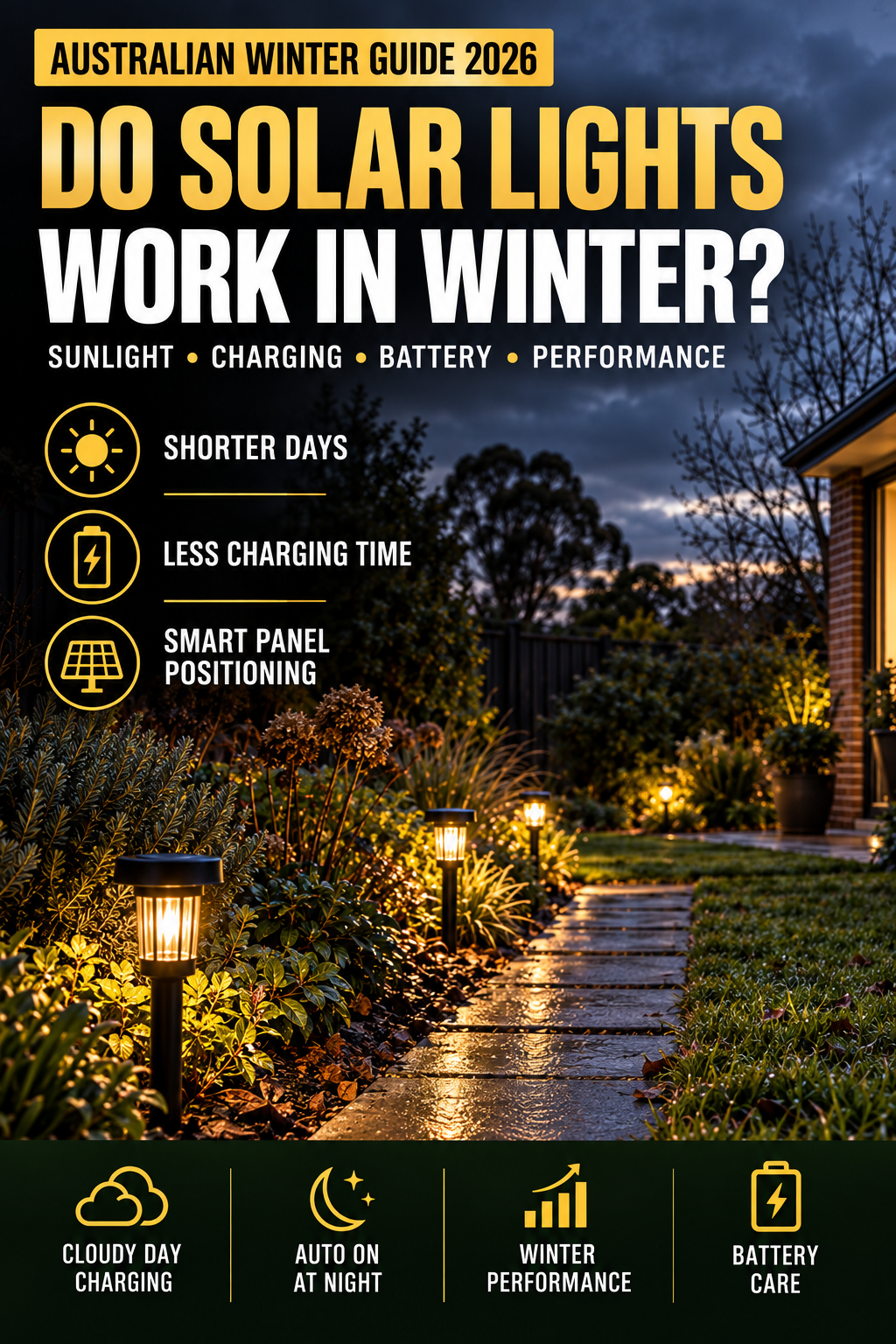
Solar lights can work during winter in Australia, but their performance may change as daylight hours become shorter and weather conditions become less favourable.
Many people notice that their solar garden lights stay illuminated for fewer hours in winter than they do in summer. This does not necessarily mean the lights are faulty. In most cases, the difference is caused by reduced solar charging, lower temperatures, shade or dirt covering the solar panel.
Understanding how winter affects solar lights can help you position, maintain and use them more effectively throughout the year.
How Do Solar Lights Work?
A solar light normally contains four main components:
- A solar panel
- A rechargeable battery
- An LED light
- A light sensor and control circuit
During the day, the solar panel converts sunlight into electricity and stores it in the rechargeable battery. When the surrounding area becomes dark, the light sensor activates the LED.
The amount of light available at night therefore depends on how much energy the solar panel collected during the day.
Can Solar Lights Charge on Cloudy Winter Days?
Yes. Solar panels can still generate electricity on cloudy days because some sunlight continues to pass through the clouds.
However, charging will usually be slower than it is under strong, direct sunlight. Several consecutive cloudy or rainy days may result in:
- Reduced brightness
- Shorter operating time
- Lights switching off earlier
- Lights failing to turn on after an especially dark day
These symptoms may be temporary. Normal performance can return after the solar panel receives one or more days of stronger sunlight.
Why Do Solar Lights Run for Less Time in Winter?
1. Shorter daylight hours
Winter days are shorter, so the solar panel has less time to charge the battery. The lights may also turn on earlier because sunset occurs sooner.
This means less energy is collected during the day while more energy may be required during the longer night.
2. Weaker sunlight
The winter sun sits lower in the sky. Depending on the position of the solar panel, this can reduce the amount of direct sunlight reaching its surface.
A location that receives excellent sunlight in summer may become shaded by a house, fence, tree or roof during winter.
3. Cloud and rain
Cloudy and wet weather reduces the solar energy available for charging. One cloudy day may have little effect, but several days of poor weather can gradually drain the battery.
4. Dirt on the solar panel
Dust, leaves, bird droppings and water residue can block part of the solar panel. Because winter sunlight is already limited, even a small amount of dirt may noticeably affect charging.
5. Battery condition
Rechargeable batteries gradually lose capacity as they age. An older battery may still operate well in summer but struggle in winter because it cannot store enough energy from shorter charging periods.
Does Cold Weather Damage Solar Lights?
Normal Australian winter temperatures do not automatically prevent solar lights from working. Solar panels can operate efficiently in cool conditions when they receive adequate sunlight.
The greater winter problem is usually reduced sunlight rather than temperature alone.
Extremely low temperatures can temporarily reduce battery performance. Moisture can also become a problem if water enters the housing and reaches the battery or electronic components.
Outdoor solar lights should therefore have suitable weather protection and intact seals.
How Much Direct Sunlight Do Solar Lights Need?
Solar lights perform best when their panels receive several hours of unobstructed direct sunlight each day.
The exact charging requirement depends on:
- Solar panel size and efficiency
- Battery capacity and condition
- LED power consumption
- Lighting mode
- Weather conditions
- Required operating time
A solar light placed in partial shade may still operate, but it will normally charge more slowly and run for less time than one placed in direct sunlight.
Bright daylight is not always the same as direct sunlight. A panel may look well lit while still receiving insufficient solar energy because it is positioned under a patio, beside a wall or behind a window.
How to Improve Solar Light Performance in Winter
Move the panel into direct sunlight
Observe the garden during the middle of the day and identify the areas receiving the strongest winter sunlight. Move the light or separate solar panel to one of these locations if possible.
Adjust the panel angle
A tilted panel may receive more winter sunlight than a panel lying completely flat. Pointing it towards the part of the sky with the strongest midday sun can improve charging.
In Australia, a generally north-facing position often receives more sunlight, although the best direction depends on surrounding buildings, trees and other sources of shade.
Clean the solar panel regularly
Wipe the panel with a soft, damp cloth. Avoid abrasive materials that could scratch its surface.
Regular cleaning is especially useful after storms, dusty weather or long periods without maintenance.
Remove seasonal shade
Check whether overgrown plants, fallen leaves or new garden structures are blocking the panel. The pattern of shade changes throughout the year, so a suitable summer location may not remain suitable in winter.
Switch off the lights while charging
If the battery has become deeply discharged after several cloudy days, switch the lights off and leave them in direct sunlight for one or two clear days.
This allows more of the collected energy to remain in the battery instead of being used immediately at night.
Use a lower brightness mode
Some solar lights offer multiple brightness or operating modes. A lower setting consumes less energy and may keep the light operating longer during winter.
Check the rechargeable battery
If the light is several years old and its operating time remains short even after strong sunlight, the rechargeable battery may have lost capacity.
Where the design permits battery replacement, use the battery type and specification recommended for that light.
How to Tell Whether the Problem Is Winter or a Fault
The light is more likely to be affected by winter conditions if:
- It works after a sunny day but not after a cloudy day
- It turns on normally but operates for fewer hours
- Several lights in the same area show similar behaviour
- Performance improves after moving the panel into direct sunlight
A fault may be more likely if:
- Only one light in a connected string remains off
- The light does not work after several full days of direct sunlight
- There is visible water inside the housing
- The panel, cable or connector is damaged
- The switch has become loose or corroded
- The battery cannot hold any charge
Before deciding that a light is faulty, clean the panel, check the switch, inspect the connectors and allow the battery to charge in direct sunlight.
Can Solar Lights Be Left Outside All Winter?
Solar lights designed for outdoor use can generally remain outside during winter, provided they are installed correctly and their weather seals remain intact.
However, prolonged flooding, poor drainage and physical damage can shorten their lifespan. Ground-mounted lights should not be installed where water regularly pools around them unless their design is specifically suitable for those conditions.
If severe weather is expected, portable decorative lights can be moved to a protected location.
Frequently Asked Questions
Do solar lights charge without direct sunlight?
They can charge in bright indirect light, but charging will usually be slower. Direct sunlight generally produces better brightness and longer operating time.
Why do my solar lights switch off early in winter?
The battery may not receive enough energy during the shorter day to operate throughout the longer night. Shade, cloud, dirt and battery age can make this more noticeable.
Will solar lights charge through a window?
A solar panel may charge behind glass, but its performance will usually be reduced. Outdoor placement in direct sunlight is preferable.
Should solar lights be switched off during winter?
They do not normally need to remain switched off. However, turning them off for one or two sunny days can help recharge a deeply depleted battery.
Why is only one light not working?
If other lights connected to the same panel are operating normally, the problem is more likely to involve that individual light, bulb, connection or section of cable rather than insufficient winter sunlight.
Final Thoughts
Solar lights can continue working throughout an Australian winter, but shorter days, cloud cover and seasonal shade may reduce their charging time and nightly performance.
The most effective winter improvements are simple: place the solar panel in direct sunlight, adjust its position, keep it clean and allow the battery time to recover after several cloudy days.
If performance does not improve after proper charging and basic checks, inspect the battery, wiring, connections and housing for signs of age or damage.